
Industries
Remote Monitoring for Off-Grid Agricultural & Environmental Sites
Monitoring and control for sites with no mains power and no fixed line, running on solar or battery and reporting over cellular, radio or satellite.
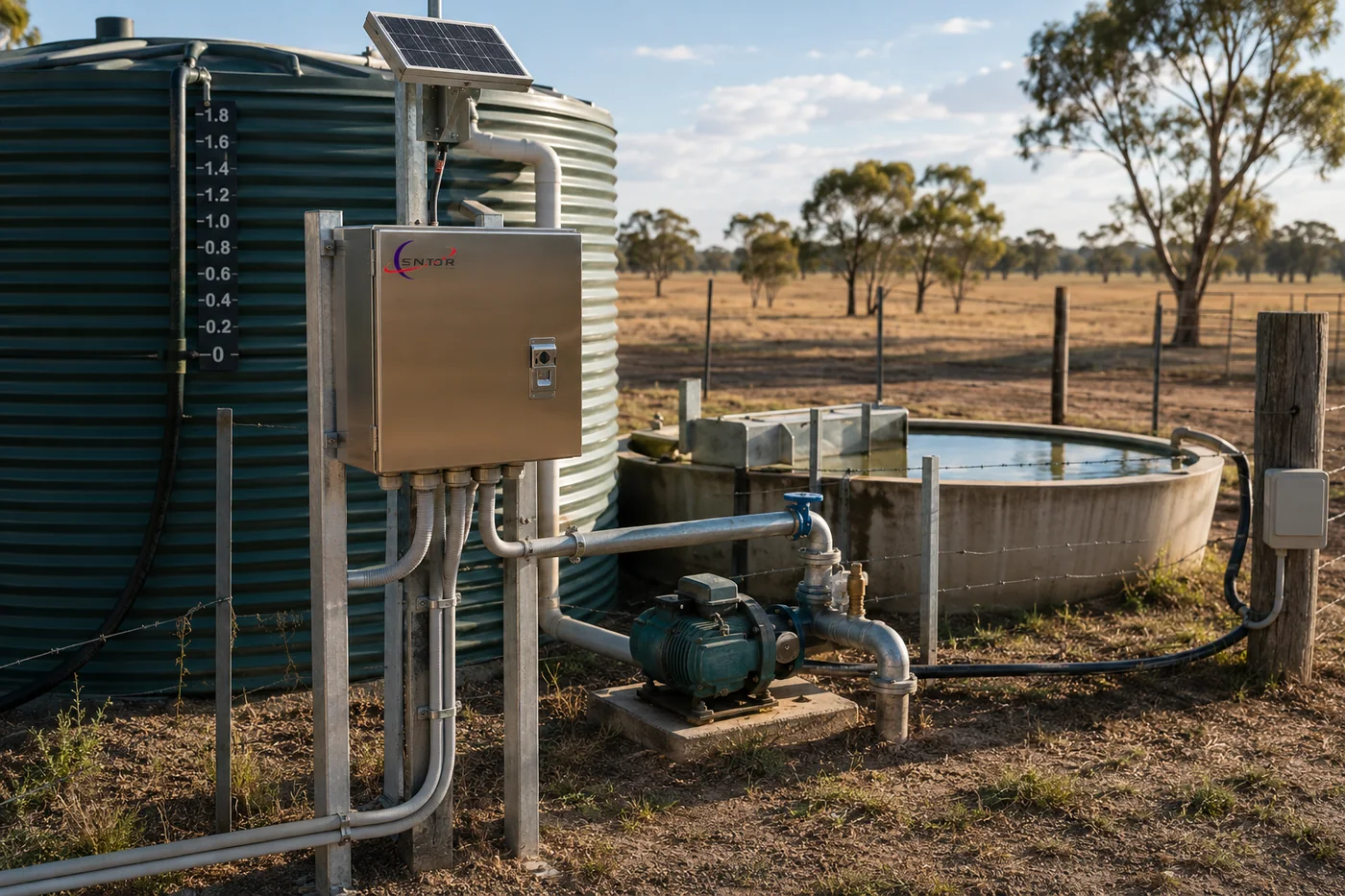
The problem
The sites that most need monitoring are the ones hardest to monitor. A bore, a pump, a tank or a weather station is typically a long drive from anyone, on no mains supply and outside fixed-line coverage, which rules out most of what the word “monitoring” normally implies. So the check happens on a schedule that suits the driving rather than the equipment, and a pump that failed on Tuesday is discovered on Friday.
How Sentor solves it
A Sentor controller is built to sit at a site like that and keep working. It runs from the power the site already has — solar, wind, a generator or a battery bank, each of which it can also monitor and control — and reports over whatever bearer reaches: cellular, radio, microwave or satellite. Because the scenario logic runs on the controller rather than on a server, the site keeps acting on what it reads even when nothing is reaching it.
What Sentor monitors
Monitored and controlled at a remote agricultural or environmental site
These sites are usually the furthest away and the least connected, which is exactly why the controller does its thinking locally and reports when something changes.
- Bore, tank, dam, trough and channel levels, with remote pump control
- Bore and pump run status, fault and remote start/stop
- Livestock tag readers at troughs, gates and yards
- Video of stock, water points and access gates
- Gates closed remotely, to muster stock without driving out
- Weather, rainfall, and air, water and soil temperature
- Air and water pollution readings at sites with no infrastructure
- Level, pressure and flow from 4–20 mA and voltage transmitters
- Linear and non-linear sensor curves, calibrated rather than assumed
- Valve and actuator operation from relay outputs
- Solar generation, wind plant and battery state of charge
- Generator status, cut-in and fuel level
- Mains loss, where a supply exists at all
- Enclosure intrusion and tamper on supervised loops
- Alarms by SMS text over a cellular network
- Up to 80 inputs per controller with ST317 expansion cards
- Cellular, radio, microwave or satellite reporting
Water and stock
A dry trough reported as it happens
On a grazing property the chain that matters is short and unforgiving: a bore stops, a trough empties, and stock are without water until somebody happens to drive past. A routine inspection round mostly confirms that everything is fine, which is the one outcome that did not need the drive.
Water
Bore, tank, dam, trough and channel levels, and bore pump status, with the pump startable and stoppable from the same screen.
Stock
Tag readers identify which animals are present at monitored points, and video shows the animals and the water — turning “the trough is full” into “the trough is full and the stock are on it”.
Gates
Gates are closed remotely from the same screen, so stock can be mustered into yards without anyone driving out to open and shut them by hand.
A 3,000-head Western Australian station running this arrangement is monitored and controlled from Perth, 590 km away, with bore site visits cut by around half. Read the case study.
Power
Running where there is no mains supply
At an off-grid site the power system is usually the thing most likely to fail and the thing least visible when it does. Sentor treats it as another monitored system rather than as an assumption.
| Supply | Handling | Detail |
|---|---|---|
| Solar | Monitored and controlled | Generation and battery state of charge read as ordinary analogue inputs |
| Wind | Monitored and controlled | Plant status and output brought in alongside everything else at the site |
| Generator | Monitored and controlled | Status, cut-in and fuel level, with remote start through a relay output |
| Battery bank | Monitored and controlled | Bank condition tracked continuously rather than checked on a visit |
| Standby battery | Up to 24 hours | An optional sealed lead-acid battery carries the controller through a supply failure |
| Total failure | State retained | An on-board lithium cell holds the programs, history log and clock; the controller restarts itself |
Off the network
The site keeps deciding while you are out of contact
Remote agricultural and environmental sites spend meaningful amounts of time unreachable — weather, terrain, coverage, power. A system that has to ask a central server what to do is, during exactly those periods, a system that does nothing.
A Sentor controller holds its scenario logic on board and acts on it locally: starting a pump when a level drops, shutting one down on a fault, opening or closing a gate, raising an alarm at the site. Reporting is how you find out afterwards. It is not how the decision gets made.
The log comes back with the link
Events are written at the site with a date and time against each one, so the hours the site spent out of contact are returned to you rather than lost.
Common questions
Off-grid and environmental monitoring, answered
There is no mains power at the site. Does that rule it out?
No — it is closer to the normal case than the exception. The controller runs from whatever supply the site has: solar, wind, a generator or a battery bank. Each of those can also be monitored and controlled by the same controller, so the power system stops being a blind spot and becomes one more thing you can see. An optional sealed lead-acid standby battery carries the controller for up to 24 hours through a supply failure, and if power fails completely an on-board lithium cell retains the programs, the history log and the real-time clock, with the controller restarting itself when power returns.
There is no internet either. How does it report?
Over whatever reaches the site. Data and alarms travel by cellular, wireless, satellite, microwave, telephone or fibre, and an alarm can be sent as an SMS text over a cellular network. Different sites on the same network can use different bearers, which matters on a property or a catchment where one location has usable mobile coverage and the next has nothing but a satellite footprint.
What can it actually measure at a site like this?
Whatever is being sensed electrically. The analogue inputs take 0–20 mA current loops — covering the 4–20 mA transmitters used for level, pressure and flow — along with 0–1 V, 0–10 V and 0–30 V instruments, linear and non-linear sensor curves, and direct temperature probes. Conversion is 9-bit at up to 20 samples per second with accuracy better than 0.5%, and a controller reaches up to 80 inputs with ST317 expansion cards. Tell us what instruments are at the site and we will confirm what connects directly.
Can it operate equipment, or only tell me about it?
It operates it. Eight single-pole double-throw relay outputs per controller, rated at 1 A at 48 VDC, switch pumps, valves, gates and actuators — either on command or automatically from the scenario logic. On a site hours away, the difference between knowing a tank is low and being able to do something about it from where you are standing is most of the value.
Will the equipment cope with the conditions?
The controller is specified for 0 to 50 °C and 5–95% relative humidity operating, and is normally installed in an enclosure suited to the site. The more useful answer for a remote property is the one about failure: the logic runs locally, the log is written locally, and a total power loss does not cost you the programming. See a working example.
Recommended configuration
- ST3000 or i7000 controller (wall mount)
- ST025 temperature sensor and environmental sensors
- ST317 expansion cards for additional inputs
- ST30G cellular or ST303 RF radio modem
- SentorCloud for remote viewing
Key benefits
- Runs on solar, wind, generator or battery
- Reports over cellular, radio or satellite
- Keeps deciding while the site is out of contact
- Operates pumps and gates without a site visit
Related