
Industries
Remote Access Control & Security Monitoring for Unmanned Sites
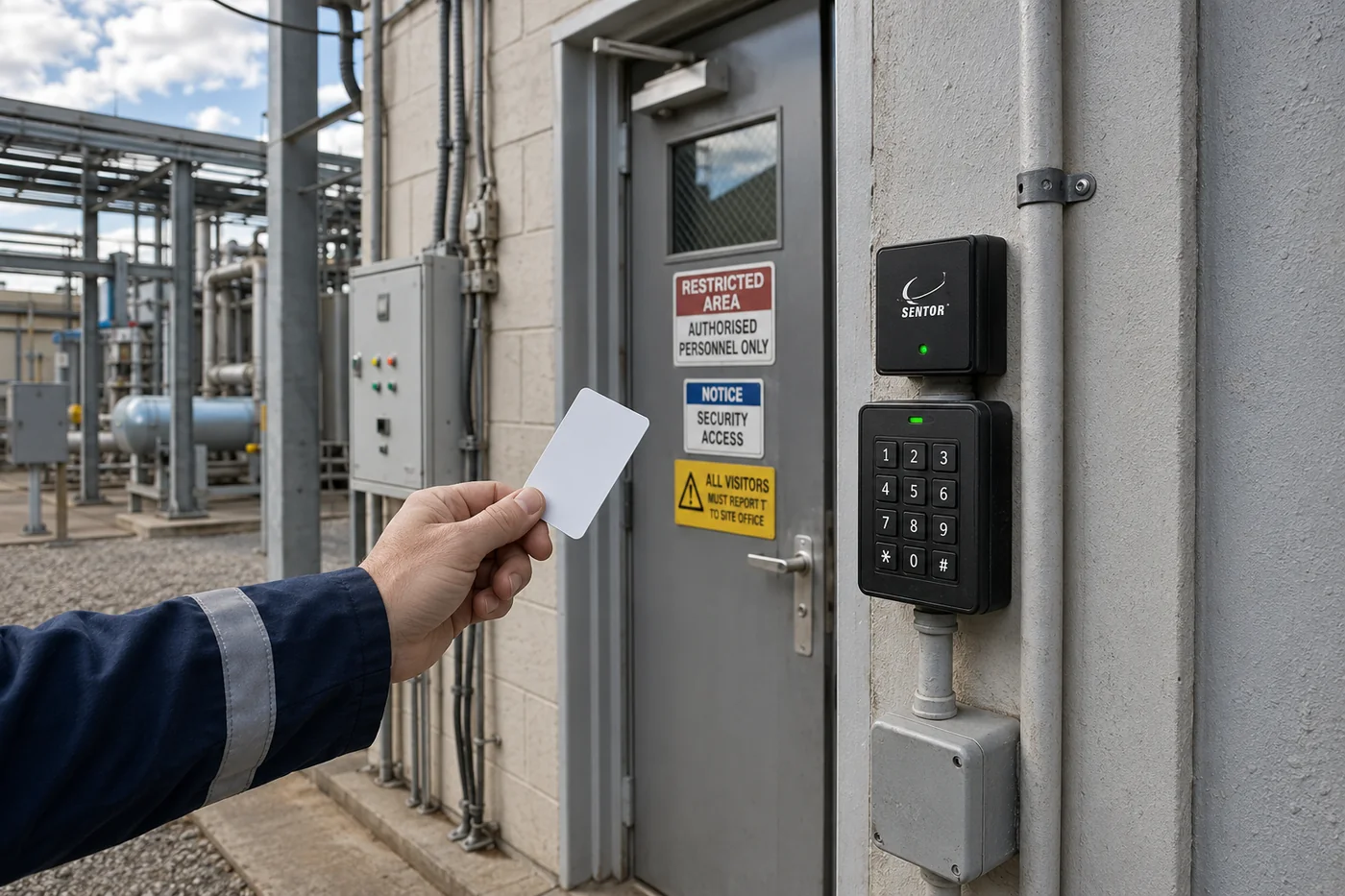
Card, keypad and biometric site access with full entry and exit logging, managed across every remote site from one system — so a card can be revoked without anyone driving to the site.
The problem
Access control at a staffed building is a solved problem. Across a network of unmanned sites it is not. Keys get copied and never returned. A contractor leaves and their card stays live because revoking it means a visit. Nobody can say with confidence who opened the shelter at a particular site on a particular night, because the record — if it exists at all — is a paper sign-in sheet in a drawer at that site. When something is damaged or missing, the investigation starts with guesswork.
How Sentor solves it
Sentor treats the door as one more thing the controller monitors and operates. Readers, keypads and door contacts wire to the same controller that watches power and environment, so access is not a separate system bolted alongside. Every presentation of a card, every correct and incorrect PIN, every door opening and every tamper is written to the on-board history log against the date and time it happened, and the same list of who may enter is applied across every site on the network.
What Sentor monitors
Monitored and controlled at site access and security
Readers, keypads, door contacts and alarm devices wire to the same controller that watches power and environment at the site.
- Card, proximity, fingerprint and iris readers via Wiegand
- Keypad entry with individual user PINs
- Door position and forced-entry detection
- Supervised tamper loops that detect a cut cable
- Gate, boom, door strike and turnstile operation
- Entry and exit logged with date and time
- Intruder panel and PIR alarm contacts
- Strobe and horn outputs on alarm
- Camera and NVR systems for visual verification
- Time-of-day and scenario-based access rules
- Remote unlock by an authorised operator
- Zone isolation for planned maintenance visits
Hardware
What reads the credential, and what operates the door
Access hardware connects to the same controller that watches power, environment and plant. There is no second system to licence, log into or keep in step.
| Module | What it is | Detail |
|---|---|---|
| ST352A Wiegand access interface | Card, proximity, fingerprint and iris readers | Supports up to 64,000 users. A current-generation model is available |
| ST007V / ST007H LCD keypad terminal | Vertical or horizontal heavy-duty backlit terminal | Individual user PINs, and shows live device readings on site. Up to 1,200 m from the controller |
| ST-PB5 fingerprint / keypad unit | Mini colour fingerprint reader with keypad | Supplied in the biometric access package |
| Access reader range | Proximity and card swipe readers | Chosen to suit the credential already in use on site |
| Door and tamper inputs | Contact closure, with end-of-line resistors for a supervised loop | A cut or shorted cable registers as a fault, not as silence |
| Relay outputs | Door strike, gate, boom or turnstile | Operated by scenario logic, by an operator, or both |
| ST5000 NVR and camera kits | Eight-channel kits, 32-channel systems available | Managed through SenVision, for visual verification of an access event |
Across sites
One list of who may enter, not one list per site
A standalone reader at each door means a separate user list at each door. It works until somebody leaves, at which point the cost of revoking their access is a drive to every site they could reach. In practice that means it does not get done, and the access list slowly stops reflecting who actually works there.
Running access through the controller changes the economics of that decision. Revoking a card is an administrative action rather than a journey, so it happens on the day it should — which is the only version of access control that is worth having.
Supervised, not just connected
Door and tamper inputs use end-of-line resistors, so the controller can tell the difference between a closed door, an open door and a cut cable. An access system that goes quiet when someone cuts the loop is not reporting security — it is reporting silence.
The record
Every entry logged, whether or not anyone mentioned the visit
The history log is written on the controller at the site, with a date and time against each record. That matters in two situations that look very different and are answered the same way: proving who had access when something went wrong, and showing an auditor a complete record rather than a reconstruction.
Because the log is kept on site, it survives a communications failure. A site that spent the night offline still hands over a full record of what happened during it.
Common questions
Remote access control, answered
Can a card be revoked without visiting the site?
That is the point of running access through the controller rather than through a standalone reader at each door. The user list is managed centrally and applied across the sites on the network, so a contractor who leaves on Friday does not still have working access on Monday because nobody could get to a site four hours away.
What gets recorded when someone enters?
The event is written to the controller’s history log with a date and time stamp. The log is a general record — alarm events, power failures and anything else configured as worth recording — so an access event sits in context alongside what else was happening at the site. It is written on site, whether or not the site was in contact with anyone at the time, which is what makes it useful in an investigation afterwards.
Does it work with the readers we already have?
If they are Wiegand, yes — the ST352A connects card, proximity, fingerprint and iris readers and supports up to 64,000 users. Wiegand is the common denominator in access control, which usually means existing readers are reused rather than replaced. Tell us the reader model and we will confirm it before you specify anything.
Can access rules depend on the time or the state of the site?
Yes. Access is handled by the same scenario logic that runs everything else on the controller, written as plain if-this-then-that statements. A rule can require a correct PIN and a particular time window, or check an interlock before releasing a gate, or start a different sequence when entry happens outside expected hours. The controller checks the conditions before acting, regardless of who asked.
How many keypads can one site have?
Up to five, connected in a bus or daisy chain, each identified by its own address. They can sit up to 1,200 m from the controller, which is usually enough to cover a gate, a compound entrance and a building door from one controller.
Recommended configuration
- ST3000 or i7000 controller
- ST352A Wiegand access interface
- ST007V/H LCD keypad terminal (up to five)
- ST5000 NVR and cameras for visual verification
- SenCheck for network-wide card updates
Key benefits
- One access list across every site
- Full entry and exit audit trail
- No site visit needed to revoke a card
- Works with card, keypad or biometric readers
Related