
Industries
Building & Facility Automation and Monitoring Systems
HVAC, lighting, access and alarms on one screen, driving the Clipsal C-Bus wiring already in the building rather than replacing it.
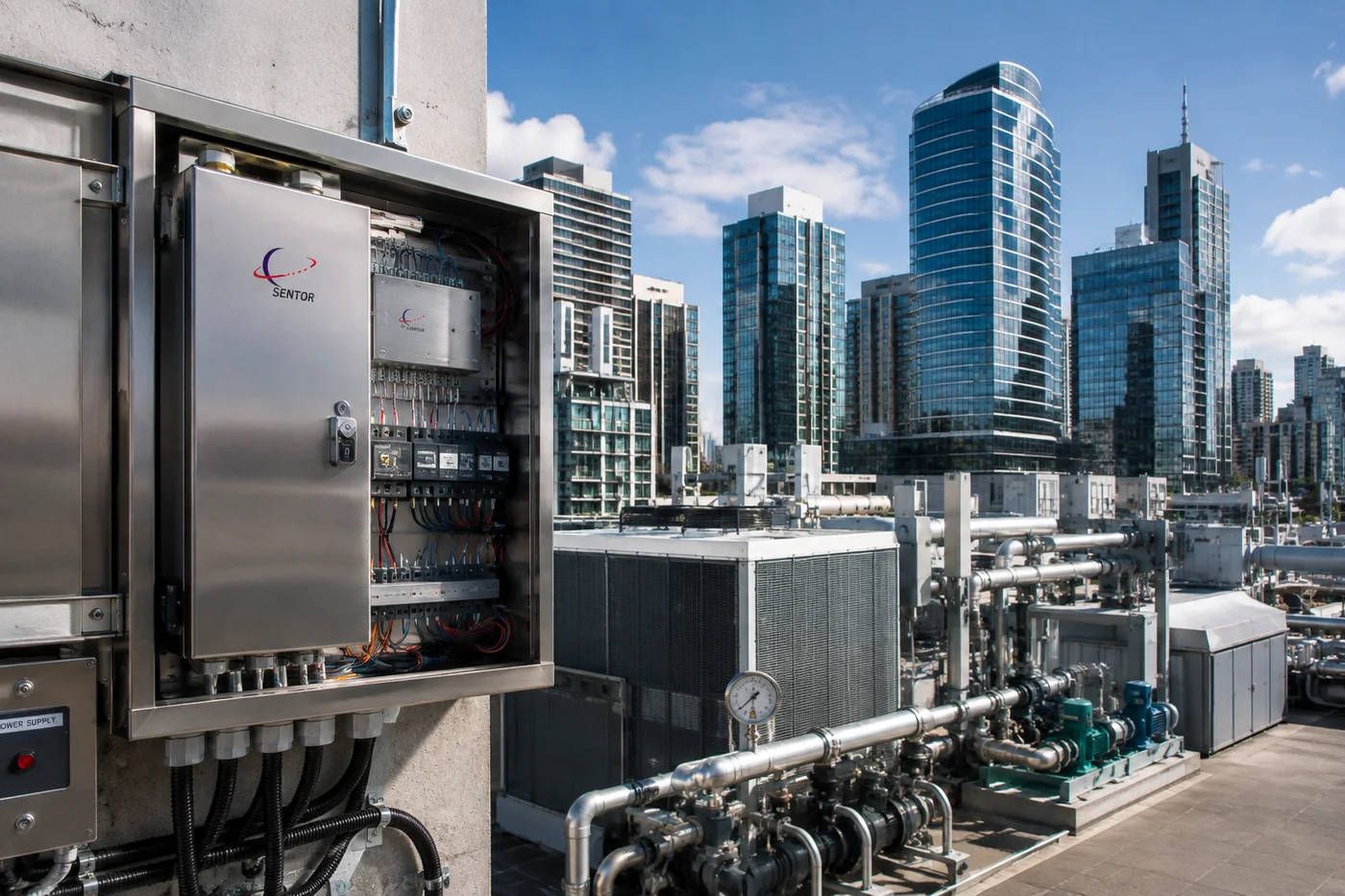
The problem
A building rarely has one control system. It has several, installed at different times by different trades: lighting on C-Bus, air conditioning on its own controller, access on a standalone panel, fire and security each reporting somewhere else. Each works. None of them talk. So the facilities manager keeps the picture in their head, and when they are on leave the picture goes with them. Across a portfolio of sites, the same problem repeats per building.
How Sentor solves it
Sentor sits underneath what is already installed. It drives Clipsal C-Bus devices directly through a C-Bus module on the controller board, switches plant through its relay outputs, reads plant status and environmental conditions through its inputs, and handles site access on the same controller. The result is one screen for the building rather than four, and the same screen across every building in the portfolio.
What Sentor monitors
Monitored and controlled at a building or facility
Most of this is read from, or switched through, equipment already installed in the building.
- Clipsal C-Bus lighting control, including dimming and scene setting
- HVAC start, stop and duty changeover through relay outputs
- Plant run status, fault and hours-run from contact closures
- Zone temperature and humidity monitoring
- Flood, smoke and fire panel alarm contacts
- Door access by card, keypad or biometric reader
- After-hours entry alerting, logged with date and time
- Intruder, duress and enclosure tamper on supervised loops
- Mains, generator and UPS condition
- Time-of-day and occupancy-based scenario rules
- Up to 80 inputs per controller with ST317 expansion cards
- Eight SPCO relay outputs per controller for plant switching
Existing wiring
Driving the C-Bus already in the building
Clipsal C-Bus is in a very large number of Australian commercial buildings, and ripping it out is rarely justifiable. Sentor speaks to it directly, which turns a replacement project into an addition.
| Aspect | Detail | What it means on site |
|---|---|---|
| What it is | A Clipsal proprietary interface | Controls AC-powered devices using signals sent over low-voltage wiring |
| How it connects | A C-Bus module in Slot 2 of the main board | Devices daisy-chain from the C-Bus terminals on the controller board |
| Wiring | Low-voltage, not AC mains | The closest device connects first, then the run extends to the rest in turn |
| Dimming | Increments of 1/255, about 0.4% | Fine enough that a change reads as a fade rather than a step |
| Ramp rate | 4 seconds to 1,020 seconds | The period over which brightness moves to the new level |
| Groups | A whole class can be dimmed at once | One instruction sets every dimmable device in the class to the same level |
One screen
Four systems that do not talk, or one that does
The cost of separate systems is not the licence fees. It is that nobody can see the whole building at once, so the connections between events — the after-hours entry twenty minutes before the plant fault, the air conditioning that has been cycling since the power blip — are only ever found afterwards, if at all.
Bringing lighting, HVAC, plant status, environment and access onto one controller means those events land in one history log, against one clock. Across a portfolio it also means every building reads the same way, which is what makes a facilities team transferable between sites.
Written by the person who knows the building
Scenario logic is written as plain if-this-then-that statements rather than code, so the rules for a building can be set by whoever actually understands how it runs.
Across a portfolio
One building is a project. Forty is a system
A single site can be managed by someone walking it. The case for automation sharpens with every additional building, because the constraint stops being attention and starts being travel.
Each building gets its own controller running its own logic locally, and all of them report into the same software. A fault at one site does not depend on the network at another, and the on-site history log means a building that spent the night off the network still hands back a complete record of it.
Common questions
Building and facility automation, answered
Do we have to replace the lighting control already in the building?
Not if it is Clipsal C-Bus. Sentor drives C-Bus directly through a module fitted to the controller’s main board, with devices daisy-chained from the C-Bus terminals over low-voltage wiring. Individual devices and whole classes can be switched and dimmed, with dimming in increments of about 0.4% and a ramp rate selectable anywhere from 4 seconds to 1,020 seconds. Existing C-Bus wiring and devices stay where they are.
Can it control the air conditioning, or only report on it?
Control. HVAC is defined as a device on an output and then driven by scenario logic, by an operator, or from a keypad on site — starting and stopping units, changing duty between machines, or running a different sequence outside occupied hours. Each controller carries eight single-pole double-throw relay outputs rated at 1 A at 48 VDC, and plant status comes back through the inputs so you can see whether the unit actually did what it was told.
Can it handle door access as well, or is that a separate system?
The same controller. Access readers, keypads and door contacts wire to the controller that is already watching the plant, so there is no second system to licence or log into. Card, proximity, fingerprint and iris readers connect through the ST352A Wiegand interface, which supports up to 64,000 users, and up to five LCD keypad terminals can sit as far as 1,200 m from the controller. Every entry is written to the history log with a date and time. More on access control.
How many points will one controller cover?
Up to 80 inputs, reached by adding ST317 expansion cards to a controller already installed rather than replacing it, plus eight relay outputs. For a portfolio, the practical planning unit is one controller per building or per plant room, each reporting into the same software, so the picture is consistent from site to site.
What happens outside business hours?
That is usually the reason a building gets monitored in the first place. Scenario logic runs on the controller and can behave differently by time of day — alerting on an entry after hours that would be unremarkable at 10 a.m., holding lighting and HVAC to an unoccupied schedule, or escalating a plant fault that nobody is on site to notice. Because the logic is local, it still applies on a night when the building’s network is down.
Recommended configuration
- ST3000 or i7000 controller
- C-Bus module for Clipsal lighting control
- ST317 expansion cards for zone sensors and plant
- ST352A access interface and ST007V/H keypads
- SitePRO for scenario programming
Key benefits
- One screen for HVAC, lighting, plant and access
- Drives the Clipsal C-Bus already installed
- Rules written in plain language, not code
- Consistent across every building in a portfolio
Related